
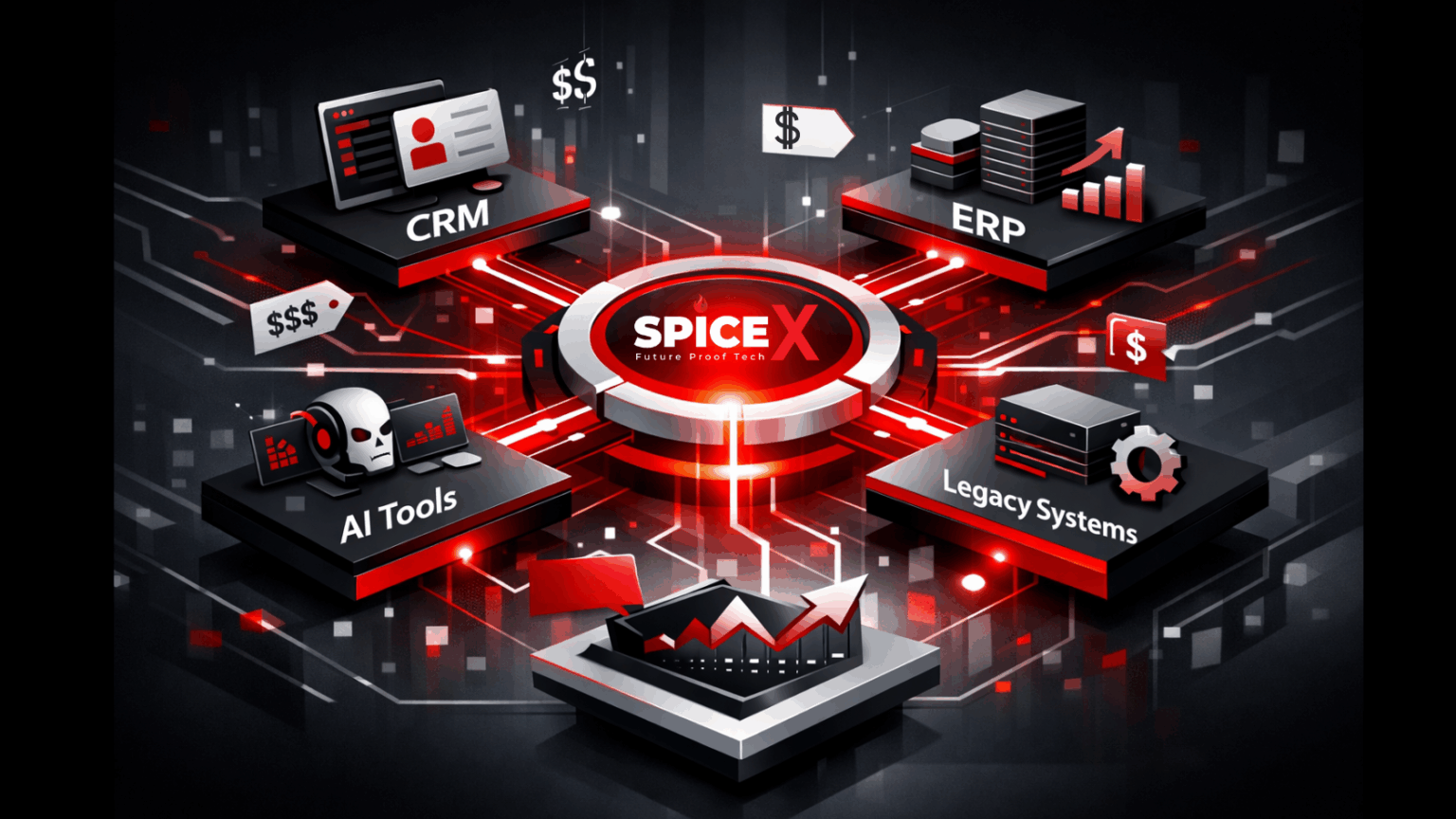
In today’s enterprise environment, companies often operate multiple CRMs, ERPs, contact centers, AI tools, and homegrown or industry-specific platforms. However, connecting these systems reliably, without rebuilding logic every time something changes, is where integration costs can quickly escalate.
What Is SpiceX?
SpiceX is a workflow and integration orchestration platform that connects CRMs, ERPs, contact centers, AI tools, and custom systems, without requiring rip-and-replace migrations.
Instead of building brittle point-to-point connections, SpiceX sits between systems. As a result, teams can design workflows once and orchestrate processes centrally across platforms.
SpiceX Is Not a CRM Replacement
Rather than replacing your existing systems, SpiceX centralizes integration logic, simplifies change management, and prevents teams from rebuilding functionality every time a system is upgraded or replaced.
When to Use SpiceX
SpiceX is purpose-built for enterprises that operate within complex digital ecosystems. In particular, it is ideal for organizations that have:
- Multiple CRMs, ERPs, contact centers, and AI tools
- Homegrown or legacy platforms with limited or inconsistent APIs
- Cross-functional workflows that don’t belong inside a single CRM
By acting as a central orchestration layer, SpiceX unifies data and processes—without requiring a disruptive migration strategy.
Realistic Integration Costs with SpiceX (2026 Market View)
When teams evaluate integration costs, they typically seek realistic planning guidance—not vague estimates or marketing promises. Fortunately, SpiceX integrations are often more predictable and cost-effective than traditional point-to-point integrations. This is because orchestration logic is centralized, rather than rebuilt across multiple systems.
Typical Integration Costs at a Glance
- Simple integration: $10,000–$30,000
- Moderate integration: $30,000–$75,000
- Complex or legacy integration: $60,000–$150,000+
These ranges reflect actual development hours, data complexity, and compliance requirements observed across real-world enterprise deployments.
Cost Bucket #1: Internal Tech & Development Hours
This is the primary driver of cost and refers to your internal team’s effort—not SpiceX licensing.
Common tasks include:
- Building custom connectors or API wrappers
- Mapping and documenting data flows
- Managing authentication and security
- Testing, validating, and hardening integrations
Estimated effort and cost:
(Assuming ~$150/hour fully burdened rate)
- Simple API integration:
40–120 hours → $6,000–$18,000 - Bi-directional workflows or complex data sync:
120–400 hours → $18,000–$60,000 - Legacy systems with poor documentation:
200–800+ hours → $30,000–$120,000+
Cost Bucket #2: SpiceX Professional Services
(Optional, but often recommended)
Many teams choose to engage SpiceX Professional Services to accelerate deployment and reduce the risk of costly mistakes.
Services typically include:
- Integration architecture design
- Custom connector development or review
- Security and compliance validation
- Deployment planning and production testing
Estimated pricing:
- Kickoff and integration planning: $5,000–$15,000
- Connector build and handoff: $25,000–$100,000+
- Full-service end-to-end delivery: $50,000–$200,000+
Naturally, final pricing depends on scope, timeline, and compliance needs (e.g., SOC 2, HIPAA).
Cost Bucket #3: Ongoing Support & Operations
Integrations are not “set and forget.” Over time, systems evolve—schemas change, APIs are updated, and new endpoints are added. Therefore, proactive support ensures long-term reliability.
Typical annual support costs:
- Self-managed: $0–$15,000
- Premium support (monitored and managed): $15,000–$60,000+
This usually includes schema change management, retry logic, monitoring, and performance tuning.
What Drives Integration Cost the Most?
Several key factors have the largest impact on your total integration cost:
- API quality: (REST/GraphQL = lower cost; SOAP or flat files = higher cost)
- Data complexity: (Flat objects = simpler; deeply nested = more complex)
- Sync direction: (Bi-directional = ~2× effort compared to one-way)
- Security and compliance: (e.g., HIPAA, SOC 2, ISO 27001)
- Retry and error-handling strategies
Real-World Integration Examples
Example A: Homegrown CRM → SpiceX
- REST API with clear documentation
- One-way contact and deal sync
- 60–120 internal dev hours + optional support
- Estimated total cost: $10,000–$30,000
Example B: On-Prem ERP → SpiceX
- SOAP APIs and flat file data exchange
- Bi-directional inventory sync
- Heavy field mapping and validation
- 300–600 dev hours + professional delivery
- Estimated total cost: $60,000–$150,000+
How to Reduce Integration Costs with SpiceX
Many teams reduce costs significantly by following these best practices:
- Use prebuilt SpiceX connectors whenever available
- Standardize data models early in the project
- Start with one-way sync to deliver early value
- Automate testing from day one to avoid regressions
Because SpiceX centralizes logic, your team doesn’t need to rebuild integrations every time a CRM, ERP, or AI system changes.
Bottom Line: Predictable, Scalable Integrations with SpiceX
Integrating homegrown or industry-specific platforms doesn’t have to be painful. SpiceX provides a scalable, future-proof approach that reduces rework and accelerates delivery.
Design once. Orchestrate centrally. Avoid rebuilding forever.