SaaS promised speed. Many organizations got sprawl instead: overlapping tools, rising per-seat costs, and fragile integrations that break every time a vendor changes something. Add regulatory fragmentation (for example, the EU Data Act) and the risk isn’t just financial, it’s operational.
In this environment, the advantage isn’t only growth. It’s sovereignty: your ability to move, adapt, and control your own digital destiny.
What “digital sovereignty” means in practical terms
Digital sovereignty is not a philosophy. It’s an operating capability:
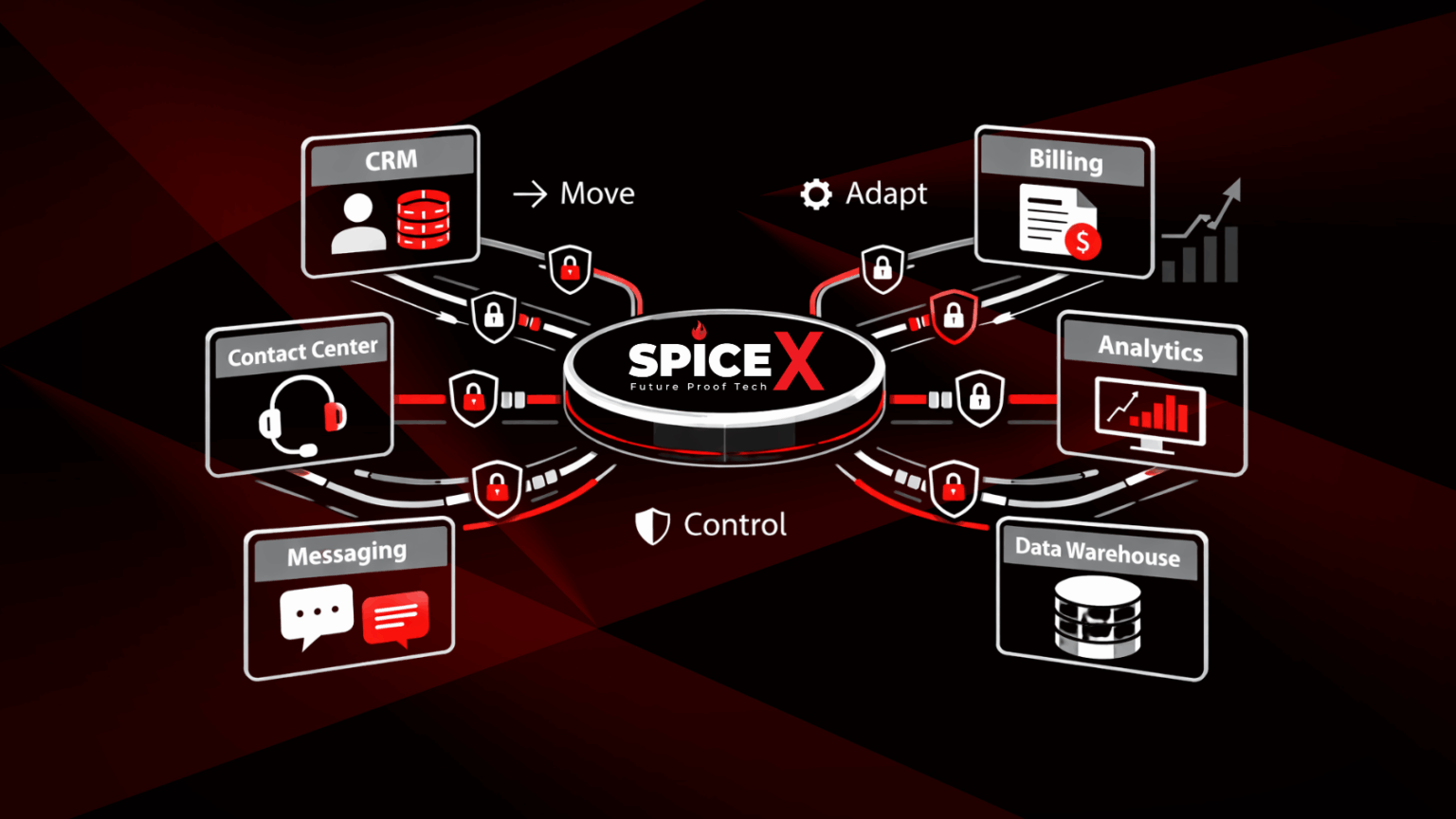
- Move: change tools and vendors without disrupting frontline execution
- Adapt: update workflows and data capture quickly as policies, products, and customer needs change
- Control: govern data movement and system access so change doesn’t increase risk
If your business can do these three things reliably, you reduce lock-in, shrink integration debt, and create room for innovation, including AI.
The Move–Adapt–Control playbook
1) Move: keep optionality in your stack
SaaS inflation gets worse when switching becomes impossible. “Move” capability comes from designing your operating model so a tool can change without everything collapsing.
What this looks like:
- Avoid “one-off” point-to-point integrations where possible (they become brittle and expensive)
- Standardize what “customer,” “case,” and “activity” mean across systems
- Treat integrations as strategic infrastructure, not one-time projects
Sovereignty signal: you can replace or add a system without rewriting every workflow.
2) Adapt: make change routine, not traumatic
Most organizations can implement a process once. The hard part is changing it repeatedly without data drift or operational chaos.
What this looks like:
- Enforce consistent data capture formats (so reporting and downstream systems don’t degrade)
- Reduce manual re-keying and swivel-chair work (the #1 source of silent errors)
- Centralize workflow guidance so teams follow the same steps every time
Sovereignty signal: you can change workflows in days or weeks—not quarters—and the data stays consistent.
3) Control: govern the flow of data, not just access to apps
Security and compliance are often treated as “who can log into what.” But real operational risk is frequently in how data moves—especially when humans copy/paste between tools.
What this looks like:
- Minimize direct user access to systems of record where feasible
- Control what data transfers at each step in a process
- Maintain an auditable trail of actions and updates
Sovereignty signal: your data flow is intentional and governed, not dependent on individual behavior.
Where SpiceX fits: sovereignty through integration and orchestration
A sovereignty-first strategy needs a practical mechanism to connect systems, enforce consistent data, and keep work moving, without forcing a disruptive rebuild.
SpiceX Data Integration is positioned around several sovereignty-aligned principles:
- No rip-and-replace: augment the tools you already rely on instead of swapping everything out upfront
- Integrate even without APIs: maintain momentum even when legacy systems don’t connect cleanly
- Secure, controlled data movement: govern what data moves and when, reducing direct user access to systems of record
- Data integrity focus: standardize capture to avoid “garbage in, garbage out” dynamics
- Unified desktop outcome: bring the right context into a single workspace so teams stop tab-switching and re-keying
In other words: integration becomes the foundation for repeatable execution…the core requirement for sovereignty.
Why sovereignty is the prerequisite for AI
Many AI initiatives fail for non-technical reasons:
- inconsistent identifiers across systems
- incomplete context (data scattered)
- uncontrolled access to sensitive systems
- no execution layer to turn “insight” into “action”
Sovereignty solves these upstream. When your stack can move, adapt, and control data flow, AI becomes easier to deploy safely and measure objectively.
What to measure to prove sovereignty (and ROI)
If you want sovereignty to be more than a slogan, measure it:
- Change lead time: how quickly you can update a workflow end-to-end
- Swivel-chair rate: % of tasks requiring copy/paste or manual re-entry
- Integration break frequency: how often changes cause failures
- Data completeness and consistency: required fields present and standardized
- Operational efficiency: handle time / resolution time trends after unifying context
These metrics turn “digital destiny” into an operating system you can manage.
Closing: growth is optionality plus control
In a world of SaaS inflation and fragmented obligations, sustainable growth comes from optional stack decisions and governed data movement—not from adding more tools.
Don’t just grow. Be sovereign.
If you want to operationalize sovereignty, start with the work that breaks most often: data movement, workflow change, and frontline execution. Platforms like SpiceX are designed to support that shift by integrating systems without rip-and-replace and turning scattered data into controlled, usable operations.
FAQ
What is digital sovereignty in operations?
The ability to move between tools, adapt workflows quickly, and control governed data flow across systems.
Why does SaaS inflation increase operational risk?
Because overlapping tools and fragile integrations create higher costs, more manual workarounds, and more points of failure.
How does SpiceX support sovereignty?
By enabling no rip-and-replace integration (including systems without APIs), controlling data movement securely, improving data integrity, and unifying operational context in one workspace.